Industrial Bag Filter
Structure, Working Principle and Maintenance


Structure, Working Principle and Maintenance
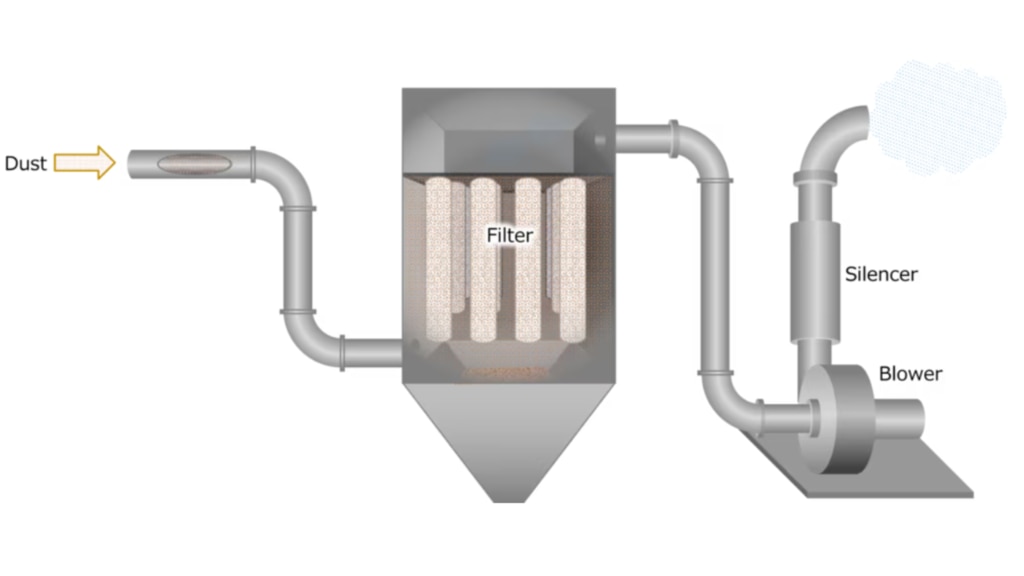
Bag Filter is a filtration type dust collector that mainly collects dust or solid particles from exhaust gas in industrial processes. It is applicable to various exhaust gases with a wide range of temperatures and compositions by selecting a suitable type of filter (filter bag). It has the advantage of being able to collect submicron particles that cannot be collected by cyclones.
Basic structure of a bag filter is almost same as a vacuum cleaner. This system filters the gas containing dust using a filter (filter bag) and only the filtered clean gas is discharged.
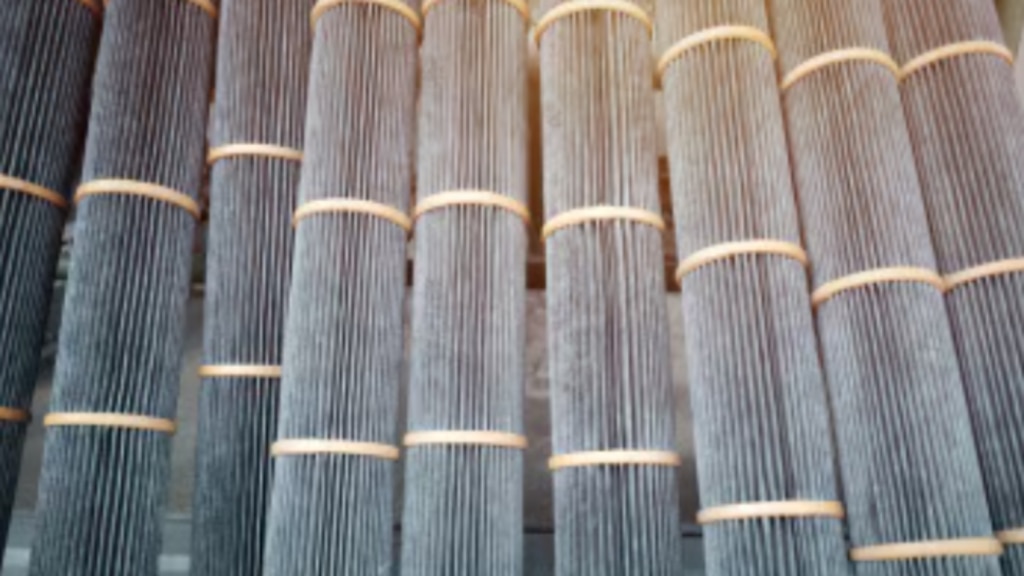
Filter materials include fibers such as polyester, heat-resistant nylon and glass fibers and are to be selected depending on the properties of the gas and dust.
Dust collection capacity may decrease if a large amount of dust adheres to the surface of the filter.
Then periodical backwashing (pulse jet) is achieved to remove the adhered dust.
Brushed off dust is stored in a dust box and is periodically discharged.
Filter bag is a consumable item. Dust may leak out if the filter is damaged and the damaged filter should be replaced. The lifespan of filter bag varies depending on the application and type of dust. Unfortunately it is difficult to determine the accurate time to replace it.
In recent years, dust monitors have been increasingly installed on the secondary side (gas discharge side) of bag filters to constantly monitor the dust leak amount. In fact, continuous monitoring the amount of dust leakage (dust concentration) with a dust monitor can help optimized timing of replacing filter cloth and reduce maintenance costs.
When bag filters are used for many years, the filters become damaged and deteriorate due to the friction of powder particles. As you can imagine, if the filter breaks, the collected powder may be released into the atmosphere but it may also cause damage to the equipment.
For example, dust will leak out if a filter is broken, and the leaked dust may adhere to the inside of the blower to cause corrosion. Due to this corrosion, loads are given on various parts of the blower, and in some cases, it may even stop. It is important to understand possible problems and take countermeasures before such a situation occurs.
When bag filters are used for many years, the filters become damaged and deteriorate due to the friction of powder particles. As you can imagine, if the filter breaks, the collected powder may be released into the atmosphere but it may also cause damage to the equipment.
Traditionally, working environment measurements based on manual analysis methods have been the mainstream, but there are periods when monitoring is not possible using only this method, and there is a possibility that leaks may go unnoticed. To avoid this, it is necessary to constantly monitor the dust concentration using a dust monitor.
Predictive maintenance is a kind of maintenance strategy focusing on monitoring actual situation of facility and predicting future failure risk.
It detects the sign of abnormality of future failure by achieving real time monitoring of machine situation with sensors or data analyzing tools.
It is possible to take countermeasures before failure happens and prevent unexpected sudden facility stop and then maximize the lifetime and occupation rate of facility.
Please feel free to ask us if you have any questions, inquiries or want our support.
Click here to download documents.
Click here for any questions.
Trivia, trends or information mainly for technologies.
Frequently Asked Questions.
WEBINAR archives available for free viewing.
© Matsushima Measure Tech