Radar Level Measurement Comparison
26GHz Pulse Radar vs 80GHz FMCW Radar


26GHz Pulse Radar vs 80GHz FMCW Radar
Radar Level Transmitters, operating at 26GHz pulse and 80GHz FMCW frequencies, offer distinct advantages in level measurement applications, with the choice between them depending on specific requirements such as beam width, resolution, and penetration depth.
The 80GHz sensors provide higher resolution and narrower beam width, while 26GHz sensors offer wider coverage and deeper penetration, making each suitable for different industrial scenarios.
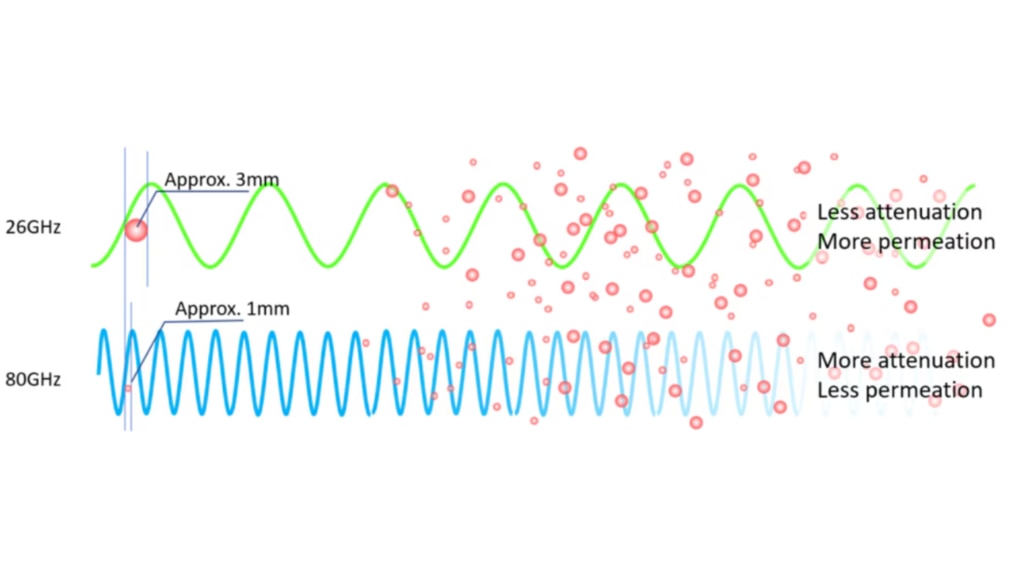
80GHz radar level transmitter operates on the FMCW (Frequency-Modulated Continuous Wave) principle, in which a continuous millimeter-wave signal is linearly frequency-swept toward the material surface.
The reflected echo returns with a frequency shift proportional to the distance traveled.
By performing frequency-domain analysis on this beat frequency, the system precisely determines the level.
26GHz pulse radar level transmitter emits short microwave pulses toward the material surface and measures the time-of-flight of the reflected signal to determine level.
The 26GHz operating frequency provides a moderate beam angle suitable for a wide range of tank sizes and process conditions.
Its pulse-based measurement method offers reliable non-contact operation, stable echo detection and robust performance in applications involving liquids, slurries and bulk solids.
Beam width is a key factor that affects the performance of radar level transmitters.
80GHz radar systems use a much shorter wavelength (3.75 mm), resulting in a very narrow and focused beam. This allows:
At a distance of 10m, the measurement area of an 80GHz radar is significantly smaller than that of lower-frequency radars, enabling precise level detection.
26GHz radar systems have a wider beam width due to their longer wavelength (approx. 11.5 mm).
This wider beam can be advantageous for:
However, a wider beam may increase the risk of interference in confined tanks.
Beam width is influenced not only by frequency but also by antenna design. Some 26 GHz radars use optimized antennas to achieve relatively narrow beam angles. Choosing between 26 GHz and 80 GHz radar depends on tank geometry, material behavior, and required measurement accuracy. Selecting the appropriate beam width is essential for stable and reliable level measurement.
The operating frequency of a radar level transmitter has a direct impact on measurement accuracy.
Higher-frequency radars, such as 80GHz, use shorter wavelengths and wider bandwidths, enabling:
These characteristics make 80GHz radar ideal for applications requiring high accuracy and detailed level measurement.
Lower-frequency radars, such as 26GHz, offer different advantages:
While higher frequencies generally provide better accuracy, the optimal radar frequency depends on factors such as measuring range, process conditions, and installation environment.
Selecting the right radar frequency requires balancing accuracy, penetration capability, and application requirements to ensure reliable level measurement.
Please feel free to ask us if you have any questions, inquiries or want our support.
Click here to download documents.
Click here for any questions.
Trivia, trends or information mainly for technologies.
Frequently Asked Questions.
WEBINAR archives available for free viewing.
© Matsushima Measure Tech